
Introduction
Michael Carrick was just confirmed as the new permanent manager of Manchester United. After taking over from Ruben Amorim in January 2026, he managed to transform a floundering team into a formidable one that has comfortably secured Champions League football for next season. However, many fans ask whether Carrick’s excellent performance can be explained by the “new manager bounce.” Is there cause for concern that Manchester United’s performance will regress next season?
In this post, we take a closer look at what the data says about mid-season appointments and their short and medium term performance.
Setting the scene
For our analysis we used Premier League data from the 2014-15 season up to and including the current 2025-26 season. We constrained our analysis to managers who were appointed in the middle of the season. This is to ensure that both the previous manager and the new manager have managed enough number of games in the same season for the comparison to be meaningful.
Evolution over the years
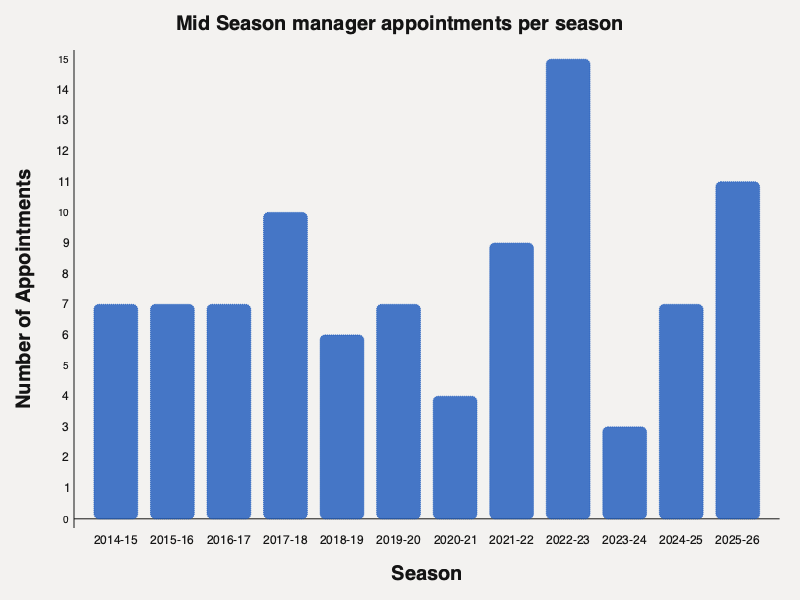
First we ask whether we see a trend in manager sackings over the years. The mid to late 2010s show a consistent pattern of 6-7 mid-season sackings per year for most years. In the 2020s, we see that it is more erratic. The 2020-21 season saw only four mid-season sackings (maybe Covid had an effect here?). However, in the next couple of seasons it grew up to a high of 15 sackings. 11 teams changed managers this season, with four of the clubs changing managers twice. Interestingly, the following season it dropped down to an all time low of three sackings. This is again followed by a growth until the current season.
Who loves mid-season sackings?
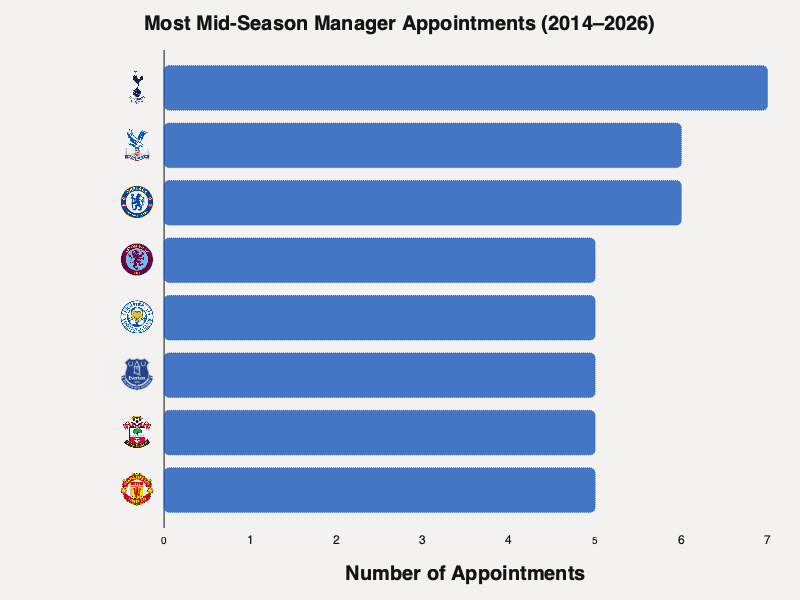
With their back to back sackings of Thomas Frank and Igor Tudor a couple of months ago, Spurs have moved to the top of the list. Their London neighbours Chelsea sit one behind, with six mid-season appointments split across the Roman Abramovich and Todd Boehly eras.
So, is there a new manager bounce?
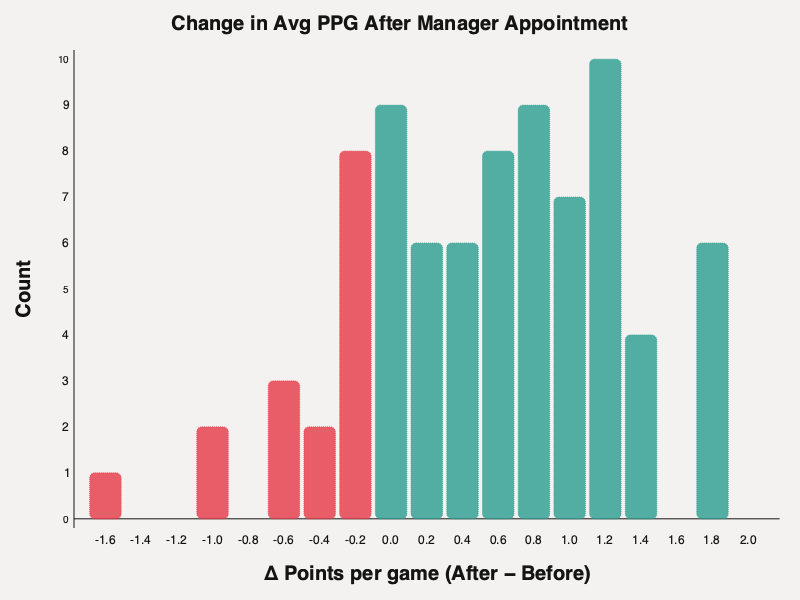
To determine whether there is a new manager bounce, we compared the points earned in the first five games of the new manager versus the last five games of the previous manager. The plot below tells us that the appointment of a new manager is overwhelmingly likely to boost the team’s results. In only 20% of the cases, we see the end of the previous manager’s tenure being more lucrative than the start of the new manager’s. So, on the surface, the new manager bounce looks real.
What do the underlying numbers say?
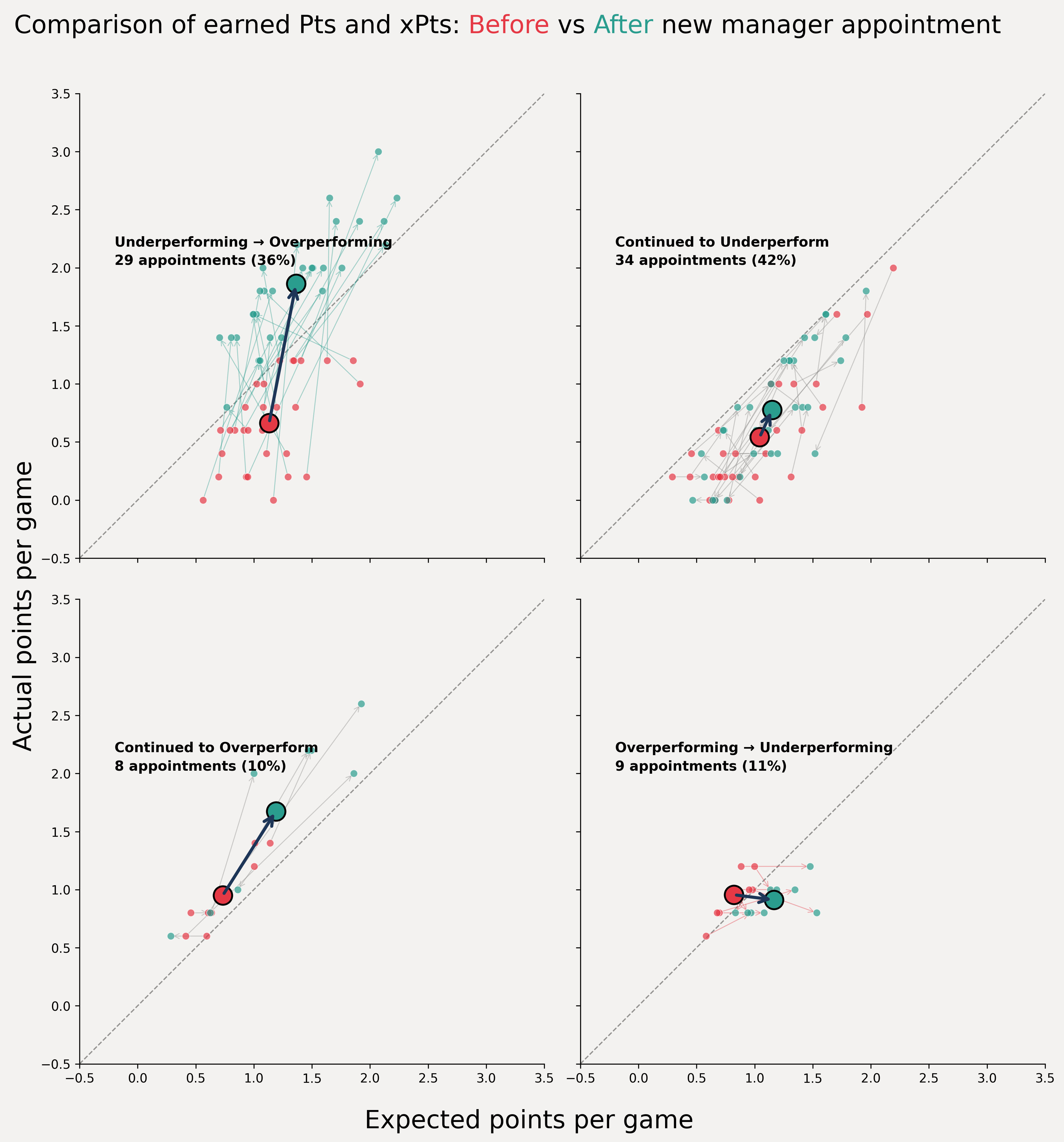
In the same five game windows defined in the previous section, we decided to compare expected points and points earned. The goal was to see if the underlying numbers can tell us something that is papered over by the points gained.
It tells us something interesting that flips the framing of our question. 78% of the managers who were sacked mid-season underperformed their expected points in their final five games.
The record of the new managers is roughly equally split between underperformers and overperformers. Only 11% of the newly appointed managers turned an overperforming team into an underperforming team.
How does it look after the bounce?
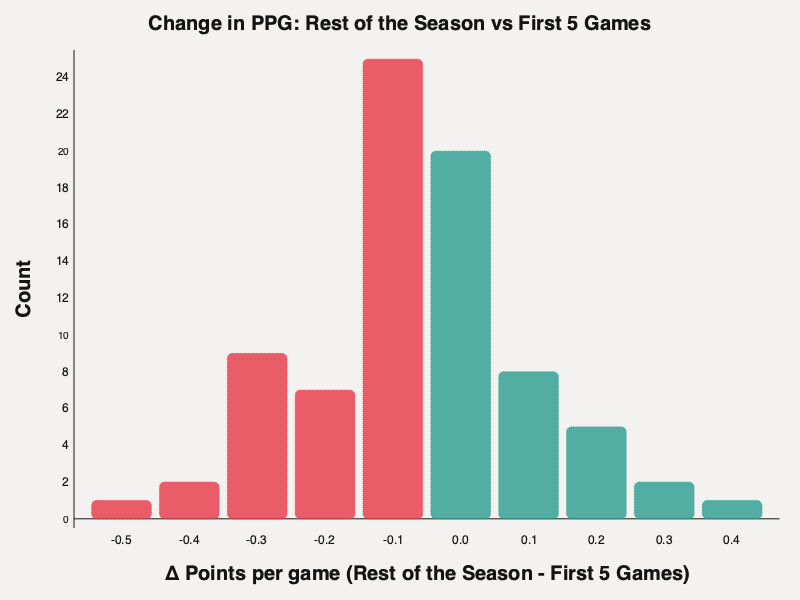
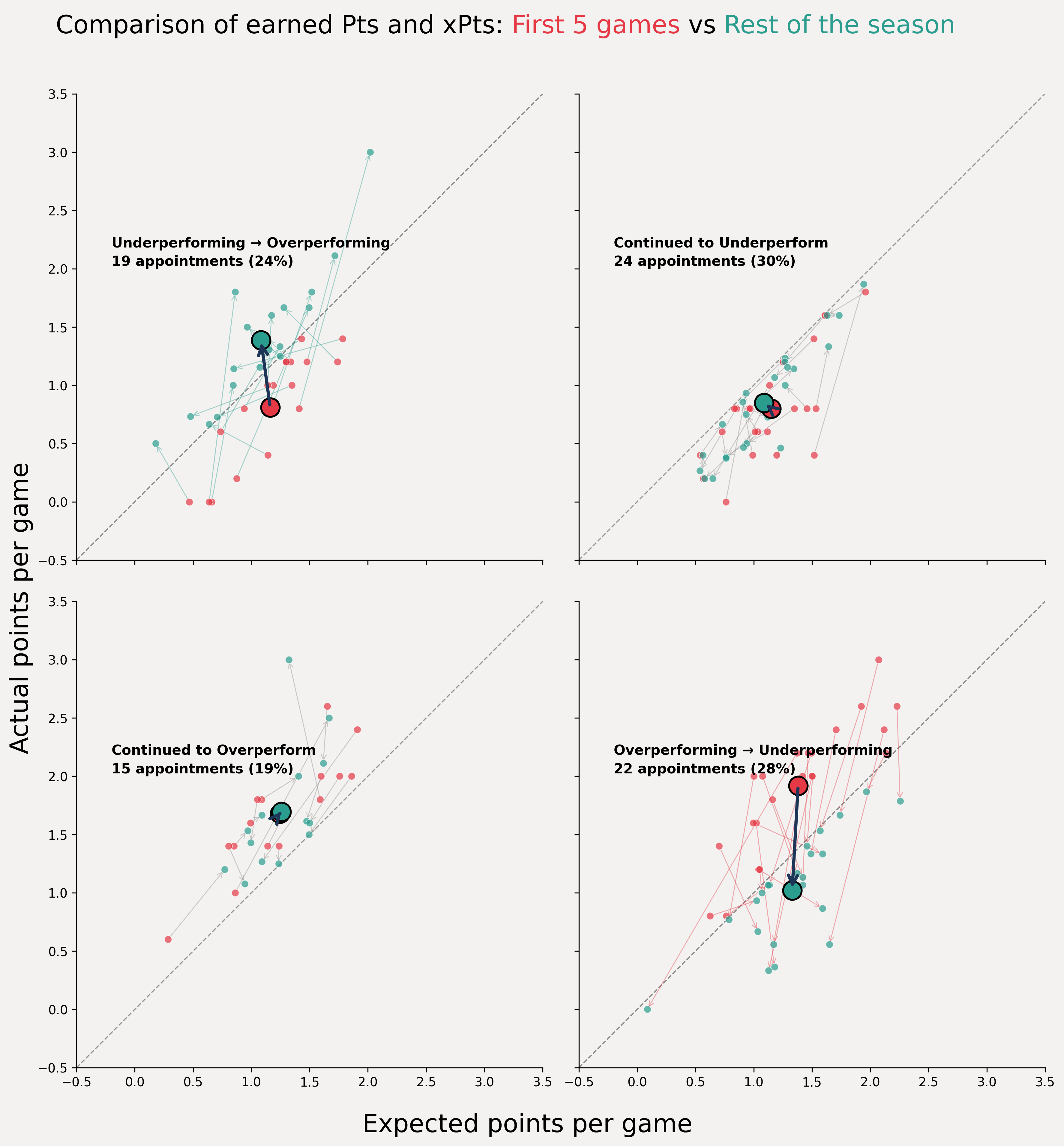
After the new manager’s first five games, it is rare to see them improve the team’s results further. Instead it is more common to see the team’s results slightly regress. However, their points per game are on average still better than at the end of the previous manager’s tenure.
Conclusion
The new manager bounce is real. It's also mostly luck. Three in four mid-season appointments produced an immediate improvement in points, but three in four sacked managers were already underperforming their expected points when they were dismissed. Most "bounces" can be explained by the same team's underlying numbers finally catching up. 28% of the teams saw an overperformance in the new manager’s first five games, and then regressed to the mean for the rest of the season. Returning to Michael Carrick, his first five matches looked like a transformation. He earned 2.6 points per game against Amorim's last five at 1.2. But the underlying numbers have remained the same since Amorim’s tenure.
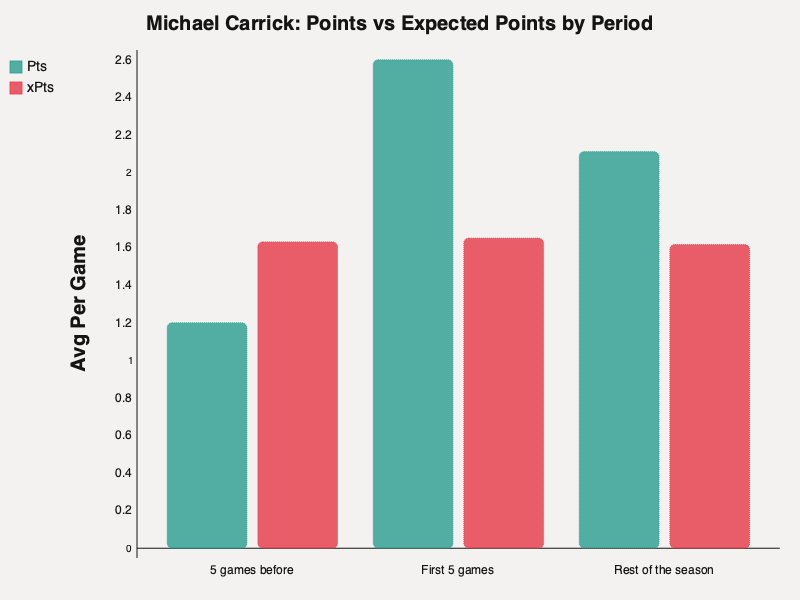
This is an unsustainable level of overperformance. If Carrick wants next season to look like this one, the underlying numbers will need to catch up to the results.